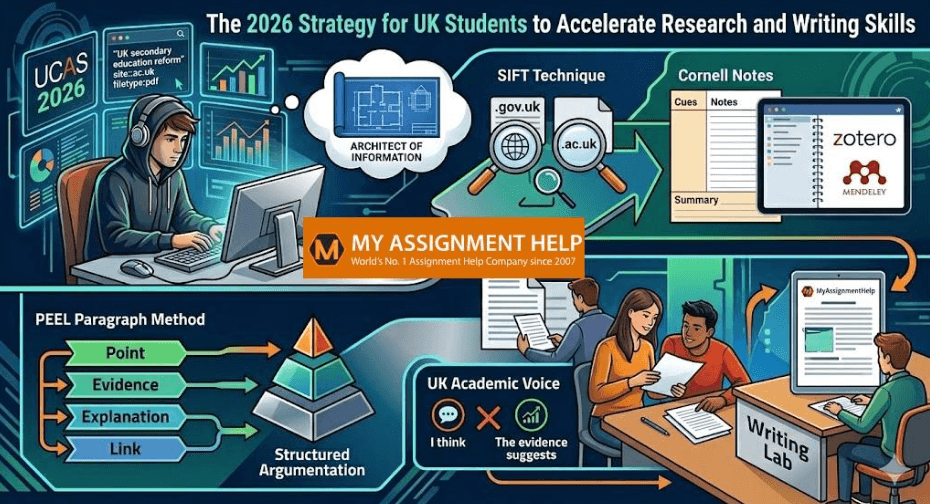
The transition from secondary school to A-Levels, and subsequently to Higher Education in the UK, represents more than just a step up in difficulty; it is a fundamental shift in cognitive expectations. Whether you are currently navigating the revised UCAS personal statement process, preparing for the Extended Project Qualification (EPQ), or tackling complex undergraduate dissertations, the ability to synthesize vast amounts of digital information and articulate it persuasively is the ultimate academic currency.
In 2026, the volume of available data is staggering. Many students fall victim to “information overload” or the dreaded “blank page syndrome.” To rank among the top performers in the current UK landscape, you must move beyond being a passive consumer of information. You must become an “Architect of Information.”
This comprehensive guide outlines a high-velocity framework for UK students to refine their research and writing skills, ensuring academic excellence while maintaining a balanced lifestyle.
1. The Pre-Research Phase: Defining the Scope
Speed in research is not about reading faster; it is about reading less of the wrong material. UK academic standards—from GCSE to PhD—prioritize “criticality” over mere “description.” Before opening a single browser tab, you must define your research parameters. If you find yourself overwhelmed by complex rubrics, you can always hire an expert to do my assignment uk to ensure these standards are met.
Establishing the “Problem Statement”
Most students start with a topic that is far too broad, such as “Climate Change in the UK.” This lack of focus leads to generic essays that rarely break the 60% mark. A high-scoring student narrows this to a specific problem: “The impact of rising sea levels on coastal property values in Norfolk, 2015–2025.” By narrowing the scope, you immediately filter out 90% of irrelevant data.
The “SIFT” Technique for Source Evaluation
The digital landscape is rife with misinformation. Use the SIFT method to ensure your bibliography remains bulletproof:
- Stop: Check if the source is reputable (e.g., .gov.uk, .ac.uk).
- Investigate the source: Who is the author? What is their specific expertise?
- Find better coverage: Can you find a more authoritative version of this claim?
- Trace claims to original context: Find the original study, not just a summary.
2. Advanced Search Strategies for the UK Market
To find the most relevant data for the UK education system, you must move beyond standard searches.
Utilizing Academic Databases
While Google Scholar is a staple, UK students should leverage institutional access to databases like JSTOR, Taylor & Francis, and the British Library’s EThOS. These platforms provide the peer-reviewed evidence required for “Grade A” or First-Class honors work. For those struggling to synthesize these complex sources, seeking coursework help online at Myassignmenthelp.com can provide the necessary academic edge.
Mastering Boolean Operators
Search smarter by using specific commands in your browser:
- “Exact Match”: Use quotation marks for phrases like “UK secondary education reform.”
- Site Limiting: Use site:.ac.uk or site:.gov.uk to filter for UK academic or government institutions.
- Filetype: Searching filetype:pdf unearths white papers and formal reports that standard web pages miss.
3. High-Velocity Note-Taking Systems
The biggest “time-sink” in academic writing is forgetting where you found a specific quote. Speed is built on organization.
The Cornell Note-Taking System
Divide your page into three sections: Cues, Notes, and Summary. This forces you to engage with the material as you read. By summarizing the key point of a paper immediately after reading, you create a “quick-reference” guide for the writing phase.
Digital Curation and Reference Management
In 2026, manual referencing is a choice, not a necessity. Use software like Zotero or Mendeley. These tools generate your bibliography and in-text citations automatically in required UK styles (Harvard, Oxford, or APA).
4. The Structural Blueprint: Writing with Purpose
In the UK education system, structure is often as important as content. A well-structured essay guides the examiner through your logic without friction.
The PEEL Paragraph Method
Every paragraph in a high-level academic piece should follow the PEEL structure:
- Point: State the main argument of the paragraph.
- Evidence: Back it up with a specific citation or data point.
- Explanation: Explain how the evidence supports your point.
- Link: Connect this paragraph back to the overall essay question.
5. Developing a Sophisticated Academic Voice
UK examiners look for a “formal” and “objective” tone. Moving away from “I think” toward “The evidence suggests” or “It can be argued that” immediately elevates the authority of your work.
Precision Over Complexity
In UK academia, clarity is king. Use precise terminology (e.g., “socio-economic” instead of “money-related”) but keep your sentence structures clean. Avoid “purple prose” that obscures your actual argument.
6. The Role of External Support and Peer Review
Writing is rarely a solo endeavor. To improve faster, you need feedback loops that highlight your blind spots.
Utilizing Institutional Resources
Most UK universities offer writing labs. These are underutilized resources where specialists help you refine your argumentative flow or check your referencing accuracy.
Leveraging Professional Guidance
Sometimes, the leap between levels—such as moving from GCSE to A-Level—is too steep to navigate alone. For students who need a concrete template of what “excellence” looks like, MyAssignmentHelp provides model papers and expert guidance. Analyzing a professionally written piece serves as a powerful “blueprint” for your own work, helping you understand the nuances of high-level UK formatting and argumentation.
7. Productivity Frameworks for the Modern Student
Deep Work vs. Shallow Work
Research and drafting require 90-minute blocks of uninterrupted focus (Deep Work). Checking emails or social media is Shallow Work. Never mix the two.
The Pomodoro Technique
If you are struggling to start, use the Pomodoro Technique: 25 minutes of intense writing followed by a 5-minute break. This prevents the mental fatigue that leads to procrastination.
See also: Understanding Partnership Announcements
Frequently Asked Questions
Q.1 How can I improve my research skills for A-Levels and the EPQ?
The key is moving beyond general web searches. Focus on using academic databases and “site:” commands to find official UK reports. Additionally, implementing the SIFT method ensures you are only using credible, high-mark-yielding sources.
Q.2 What is the most common mistake in UK undergraduate writing?
The most common error is being too “descriptive” rather than “critical.” Many students simply list what happened or what an author said. To reach higher grade boundaries (2:1 or First), you must analyze why the information is significant and how it relates to your specific thesis.
Q.3 How do I cite sources correctly in Harvard or APA style?
In the UK, referencing styles vary by department. Always check your university’s specific handbook. However, using a reference manager like Zotero can automate this process, ensuring that every comma and italicized title is in the correct place according to UK standards.
Q.4 How can I write a 2,000-word essay in one day?
While not recommended for every assignment, it is possible through “Deep Work” sessions. Break the day into four 90-minute blocks. Use the first block for finalizing your outline, the second and third for drafting using the PEEL method, and the final block for editing and referencing.
Q.5 Are professional academic support services legal in the UK?
Yes, services that provide model answers, tutoring, and research assistance are legal and widely used as educational aids. Platforms like MyAssignmentHelp provide students with a “gold standard” example of how an assignment should be structured and argued, which students then use to inform their own original work.
9. Conclusion: The Path to Academic Mastery
Improving your research and writing skills is a series of strategic adjustments. By narrowing your focus, mastering digital tools, and adhering to structural frameworks, you can drastically reduce the time spent on assignments while increasing quality.
For the UK student in 2026, the goal is to be a master of digital literacy. Use the resources available to you—from the British Library to specialized academic support services—and approach every essay with precision.
About the Author – Drake Miller
I am a passionate blog author associated with Myassignmenthelp.com, known for creating insightful content on education, student life, academic challenges and modern learning trends. His writing focuses on helping students improve productivity, manage assignments effectively, and stay updated with evolving educational practices. Drake combines practical advice with engaging storytelling to make academic topics informative, relatable, and easy to understand for readers worldwide.